


Stacked hero
Section heading
/ / / Physical
Coriolis meters: a slipstream instead of the process line
A Coriolis meter measures the force in a curved pipe as mass moves toward and away from a center of rotation. It is the gold standard for fluid-specific work, with extremely high accuracy there.
Prose
Section heading
How a Coriolis meter reads density
The meter measures the force from a change in mass flow. It needs a sample, or a calibration in a flow loop that mimics the end use.
It is the most widely used technique and works in many applications. Its strength is fluid-specific work where precision matters, including petroleum and natural gas. On larger lines, a slipstream is added.
It is also used in mining, food and beverage, chemical, and oil and gas. The average Coriolis meter in the field is 0.5 in.
Prose
Section heading
Where it falls short on slurry
Here is where Coriolis typically trades off on slurry, as stated in the technology overview.
- Line sizes are small, or the meter sits on a sample line. On a larger process line it needs a slipstream.
- It is impractical in large diameters, where the components get complex and costly.
- Abrasive media in the indirect flow path can easily damage or destroy the measuring portion. It wears quickly on abrasive slurry and has a low tolerance for it.
- It fails on material with entrained gas.
- High cost.
Prose
Section heading
What a Red Meter does differently
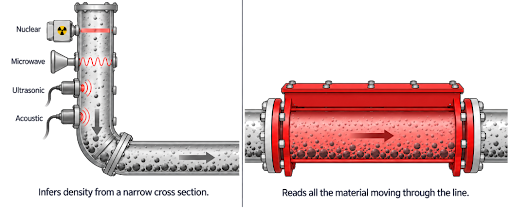
A Coriolis meter measures force from mass flow, often on a sample or a slipstream. The Red Meter reads the full bore of your process line. You get density, temperature, pressure and vibration from one device at the same moment.
The Red Meter installs inline between flanges, with no bypass and no probe in the flow. It uses a Class 1 laser, so there is no radioactive source to license.
Percent solids comes from a Red Meter alone. Connect an external 4-20 mA flow meter for mass flow and totalized solids. Readings are continuous and an integrated computer records them. Remote support is built in, and you can send readings to a third-party system.
Comparison table
Section heading
Coriolis against a Red Meter
| The Red Meter | Coriolis | |
|---|---|---|
| Principle | Class 1 laser reads deflection of the full bore | Force in a curved pipe from a change in mass flow |
| What is measured | Full bore. Density, temperature, pressure and vibration at the same moment. | Often a sample or a slipstream. Field average size 0.5 in. |
| Contact with media | Inline between flanges. No bypass. No probe in the flow. | The fluid flows through the meter |
| Radiation source | No radioactive source | No |
| Slurry limits | 2 in to 40 in pipe, rated for 0 psi and above. | Low tolerance for abrasive media. No tolerance for entrained gas. Wears on abrasive slurry. |
| Typical applications | Mining, dredging, oil and gas, and power. | Fluid-specific work, including petroleum and natural gas. Precision duties. Mining, food and beverage, chemical, oil and gas. |
Prose
Section heading
A 6 in process line against a 1 in slipstream
A large mining company ran a Red Meter beside a Coriolis meter on a slurry line. The 6 in Red Meter was in the process line. The Coriolis meter was on a 1 in slipstream. Each instrument measured specific gravity and percent solids by volume across a range of process variation.
The data from the Coriolis meter appeared damped or conditioned.
Link list
Section heading
See the proof and the specs
- The Red MeterSpecifications and install.
- Case studiesResults from working lines.
- MiningDensity on mining lines.
- Explore the TechnologyThe full-bore measurement.
Call to action
Section heading
Bring us your line size
If your Coriolis meter is on a slipstream, tell us. We will tell you whether a Red Meter can go in the process line.
Button, primary
Book a Demo