


Stacked hero
Section heading
/ / / Energy-based
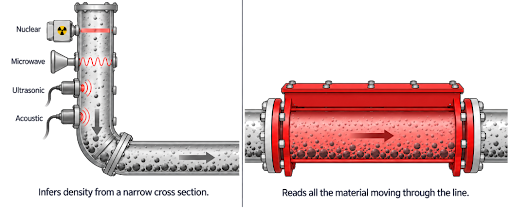
Microwave meters: a small cross-section of a stable slurry
A microwave meter uses microwaves to measure density. It is used in water and wastewater, pulp and paper, food and beverage, and construction.
Prose
Section heading
How a microwave meter reads density
Methods include microwave propagation speed, amplitude reduction, time of flight, single phase difference and dual phase shift.
The mixtures it suits are homogenous, with low suspended solids.
Prose
Section heading
Where it falls short on slurry
Here is where microwave typically trades off on slurry, as stated in the technology overview.
- It can only measure a small cross-section of the sample at a time.
- Low accuracy.
- It loses accuracy as percent solids increases, and as pipe diameter increases.
- Best for stable percent-solids slurries.
- Low solids. Mostly homogenous slurries, and commonly low suspended solids.
Prose
Section heading
What a Red Meter does differently
A microwave meter measures a small cross-section. The Red Meter reads the full bore. You get density, temperature, pressure and vibration from one device at the same moment.
The Red Meter installs inline between flanges, with no bypass and no probe in the flow. It uses a Class 1 laser, so there is no radioactive source to license. Readings are continuous and go to a third-party system if you want them there. Remote support is built in.
Comparison table
Section heading
Microwave against a Red Meter
| The Red Meter | Microwave | |
|---|---|---|
| Principle | Class 1 laser reads deflection of the full bore | Microwave propagation, amplitude, time of flight, or phase shift |
| What is measured | Full bore | A small cross-section at a time |
| Radiation source | No radioactive source. | No. Uses microwaves. |
| Slurry limits | 2 in to 40 in pipe, rated for 0 psi and above. | Stable, low solids. Accuracy falls as solids and diameter rise. |
| Typical applications | Mining, dredging, oil and gas, and power. | Water and wastewater, pulp and paper, food and beverage, construction. |
Link list
Section heading
See the proof and the specs
- The Red MeterSee the full specifications.
- IndustriesEvery industry a Red Meter serves.
- Case studiesResults from working lines.
Call to action
Section heading
Tell us if your slurry is stable
Percent solids and whether your mixture stays homogenous decide if microwave can work. Tell us both.
Button, primary
Book a Demo