


Stacked hero
Section heading
/ / / Energy-based
Nuclear density gauges: a slice of the pipe and a source to license
A nuclear density gauge counts the radiation that passes through a layer of material. It is the most common density gauge, used most in mining and dredging. It also puts a radioactive source on your site.
Prose
Section heading
How a nuclear gauge reads density
Denser material absorbs more gamma radiation, so the gauge counts less of it.
It clamps on and never touches the media, which helps on highly abrasive or corrosive slurries and at high pressure. It works best on vertical pipework. Among energy-based sensors it handles the highest percent solids.
It is also used in civil construction and petroleum.
Prose
Section heading
Where it falls short on slurry
Here is what measuring a layer with a radioactive source typically costs on slurry, as stated in the technology overview.
- It reads a layer of material, so part of the bore goes unmeasured.
- It uses a radioactive source, which brings the source-specific licensing, radiation-safety and disposal obligations associated with nuclear density gauges.
- It emits radiation constantly.
- It depends on calibration and on manual intervention.
- Low accuracy and a slow sample speed.
Prose
Section heading
What a Red Meter does differently
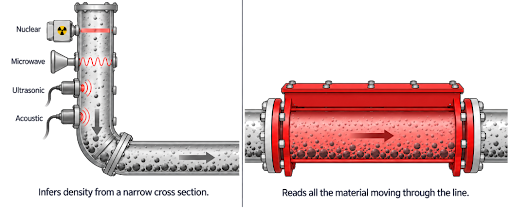
A nuclear gauge reads a layer. The Red Meter reads the full bore. You get density, temperature, pressure and vibration from one device at the same moment.
The gauge needs a radioactive source. The Red Meter uses a Class 1 laser, so you have no source to license or dispose of.
The gauge clamps on. The Red Meter installs inline between flanges, with no bypass and no probe in the flow.
Percent solids comes from a Red Meter alone. Connect an external 4-20 mA flow meter for mass flow and totalized solids. Readings are continuous and an integrated computer records them. Remote support is built in, and you can send readings to a third-party system.
Comparison table
Section heading
Nuclear gauge against a Red Meter
| The Red Meter | Nuclear density gauge | |
|---|---|---|
| Principle | Class 1 laser reads deflection. Pressure and temperature corrections are applied. | Count rate of gamma radiation through a layer of material |
| What is measured | Full bore. Density, temperature, pressure and vibration at the same moment. | A layer of material |
| Contact with media | Inline between flanges. No bypass. No probe in the flow. | Clamp-on. No interaction with the media. |
| Radiation source | No radioactive source. | Yes. Constantly emitting. |
| Slurry limits | 2 in to 40 in pipe, rated for 0 psi and above. | Highest percent solids of the energy-based sensors. Vertical pipework. High pressure. |
| Typical applications | Mining, dredging, oil and gas, and power. | Mining and dredging. Civil construction and petroleum. |
Prose
Section heading
60 days in series with a nuclear gauge
An 8 in Red Meter ran in series with the plant's nuclear density gauge for 60 days. Average pressure was 242 ± 8 psig.
Section A, dense phosphate, both means were 1.321 specific gravity. Section B, lighter potassium, nuclear 1.102 and a Red Meter 1.130. Section C, transitional feed, nuclear 1.119 and a Red Meter 1.116.
Prose
Section heading
Same process mean as a nuclear gauge
An established mining company compared a Red Meter with a nuclear density meter on specific gravity, in its own production media. The means were similar, so both instruments were reading the process mean.
Link list
Section heading
See the proof and the specs
- Read the studyPhosphate and potassium, Utah. The side-by-side specific gravity table.
- The Red MeterHow it works, and the specifications.
- Explore the TechnologyThe full-bore measurement.
- MiningWhere nuclear gauges are used most.
Call to action
Section heading
Bring the gauge you have
Tell us where the gauge sits today and what runs through the line. We will tell you whether a Red Meter can go inline on that line.
Button, primary
Book a Demo