


Stacked hero
Section heading
/ / / Energy-based
Ultrasonic meters: accuracy that drops as solids rise
An ultrasonic meter infers a change in density from the change in sound velocity and acoustic impedance. It is used where the meter may need to move, on low percent-solids slurries.
Prose
Section heading
How an ultrasonic meter reads density
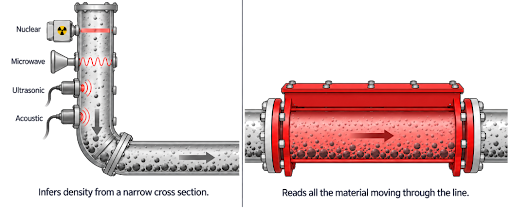
The meter uses the change in sound velocity, and the acoustic impedance of slurry moving through a pipe, to determine the change in density.
It is common where the meter needs to move, with some mining use. It only applies to low percent-solids, low-abrasion slurries. It often stands in for a nuclear gauge on low-density media.
Prose
Section heading
Where it falls short on slurry
Here is where ultrasonic typically trades off on slurry, as stated in the technology overview.
- Low accuracy, and lower accuracy again as solids content rises.
- Susceptible to abrasion.
- Susceptible to swings in density, percent solids, vibration and temperature.
- Difficulties with large diameters and fast-moving slurries.
- It requires a multi-variable calibration procedure.
- It handles a narrow range of media.
Prose
Section heading
What a Red Meter does differently
An ultrasonic meter infers density from sound velocity along one path. The Red Meter reads the full bore. You get density, temperature, pressure and vibration from one device at the same moment.
The Red Meter installs inline between flanges, with no bypass and no probe in the flow. It uses a Class 1 laser, so there is no radioactive source to license.
Percent solids comes from a Red Meter alone. Connect an external 4-20 mA flow meter for mass flow and totalized solids. Readings are continuous and an integrated computer records them. Remote support is built in, and you can send readings to a third-party system.
Comparison table
Section heading
Ultrasonic against a Red Meter
| The Red Meter | Ultrasonic | |
|---|---|---|
| Principle | Class 1 laser reads deflection of the full bore | Sound velocity and acoustic impedance |
| What is measured | Full bore | The path the sound takes |
| Radiation source | No radioactive source | No |
| Slurry limits | 2 in to 40 in pipe, rated for 0 psi and above. | Low percent solids. Low abrasion. Weak on large diameters and fast slurries. |
| Typical applications | Mining, dredging, oil and gas, and power. | Portable duties. Some mining. Low-density media in place of a nuclear gauge. |
Link list
Section heading
See the proof and the specs
- The Red MeterSee the full specifications.
- MiningDensity on mining lines.
- Case studiesResults from working lines.
- Download specifications
Call to action
Section heading
Bring us your solids and diameter
Percent solids and pipe size decide whether ultrasonic is in range. Tell us both.
Button, primary
Book a Demo