


Stacked hero
Section heading
/ / / Physical
Induced force meters: a large footprint for dredging density
An induced-force meter pushes a rigid section of pipe down with an actuator at a known force. It measures the acceleration and calculates density. It is designed for dredging.
Prose
Section heading
How an induced force meter reads density
Force equals mass times acceleration. The actuator applies a known force. The acceleration of the rigid pipe section is measured, and density is calculated from that.
It is mostly used in dredging where accuracy matters less, and it does best on heavy dredging slurries. It has some use in mining. The footprint is large and the computing power minimal. Cost is high, with a very high upfront cost.
Prose
Section heading
Where it falls short on slurry
Here is where induced force typically trades off on slurry, as stated in the technology overview.
- Very large footprint.
- Low accuracy, especially when the density change is small.
- It handles a narrow range of media.
- Very expensive.
Prose
Section heading
What a Red Meter does differently
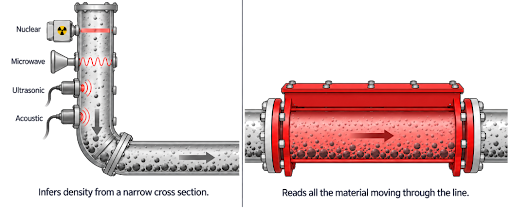
An induced-force meter weighs a moving pipe section. The Red Meter reads the full bore in the line you already run. You get density, temperature, pressure and vibration from one device at the same moment.
The Red Meter installs inline between flanges, with no bypass and no probe in the flow. It uses a Class 1 laser, so there is no radioactive source to license. Readings are continuous and go to a third-party system if you want them there. Remote support is built in.
Comparison table
Section heading
Induced force against a Red Meter
| The Red Meter | Induced force | |
|---|---|---|
| Principle | Class 1 laser reads deflection of the full bore | Known force on a rigid pipe section. Density from the acceleration. |
| What is measured | Full bore | The media in the moving pipe section |
| Contact with media | Inline between flanges. No probe in the flow. | Media inside the moving pipe. |
| Radiation source | No radioactive source | No |
| Slurry limits | 2 in to 40 in pipe, rated for 0 psi and above. | Lower accuracy on small density changes. Very large footprint. |
| Typical applications | Mining, dredging, oil and gas, and power. | Dredging, including heavy slurries. Some mining. |
Link list
Section heading
See the proof and the specs
- DredgingThe industry this meter is designed for.
- Read the studyMean solids 24.63% to 33.54% on one cutter suction dredge, Dec 2025. Results vary.
- The Red MeterSpecifications and pipe sizes.
- Download specifications
Call to action
Section heading
Bring us the deck space you have
Tell us the pipe size and whether your deck has room for a separate weighing section.
Button, primary
Book a Demo