


Stacked hero
Section heading
/ / / Compare
Choosing the right density measurement technology
No single density measurement principle is ideal for every fluid or installation. The right choice depends on what the process contains, how the meter is installed, the required accuracy, and how the data will be used.
Prose
Section heading
Two ways instruments read slurry
Energy-based sensors send energy from a source to a receiver: nuclear density gauges, ultrasonic, microwave and conductivity. They measure only the part of the media the energy reaches, so the sample is smaller than the full bore. The reading depends on whether your media suits the energy, and higher solids need a more powerful device. The group is typically lower cost and typically lower accuracy.
Physical sensors measure a force or a vibration: Coriolis, induced force, percussion and vibrational. They tend to be very large or very small, and most are Coriolis or vibrational.
Card grid
Section heading
Find the instrument on your line
Card
Nuclear density gauges
Radiation count through a layer of material. Clamp-on, with no contact with the media. Handles the highest percent solids of the energy-based sensors, but brings a radioactive source.
Card
Ultrasonic
Sound velocity and acoustic impedance. Suited to low percent solids and to meters that may need to move.
Card
Microwave
Microwave propagation through a small cross-section. Suited to stable, low-solids mixtures.
Card
Conductivity
Density from a conductive slurry, with a display of conditions in the pipe. Used in dredging and high-abrasion duties where accuracy is low.
Card
Coriolis
Force from mass moving in a curved pipe. The gold standard for fluid-specific work, with very high accuracy there.
Card
Induced force
A known force moves a rigid pipe section. Density is calculated from the acceleration. Designed for dredging.
Card
Percussion
Clamp-on. Reads the change in vibration from an impact on the outside of the pipe. Suited to low, stable densities.
Card
Vibrational
Reads a change in vibration in liquids. It cannot handle suspended solids.
Figure, single-image
Section heading
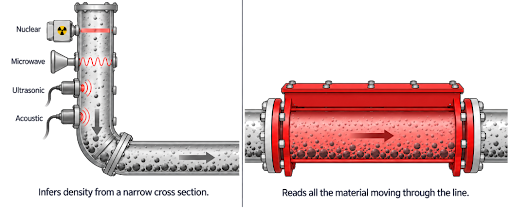
Narrow cross section and the full bore
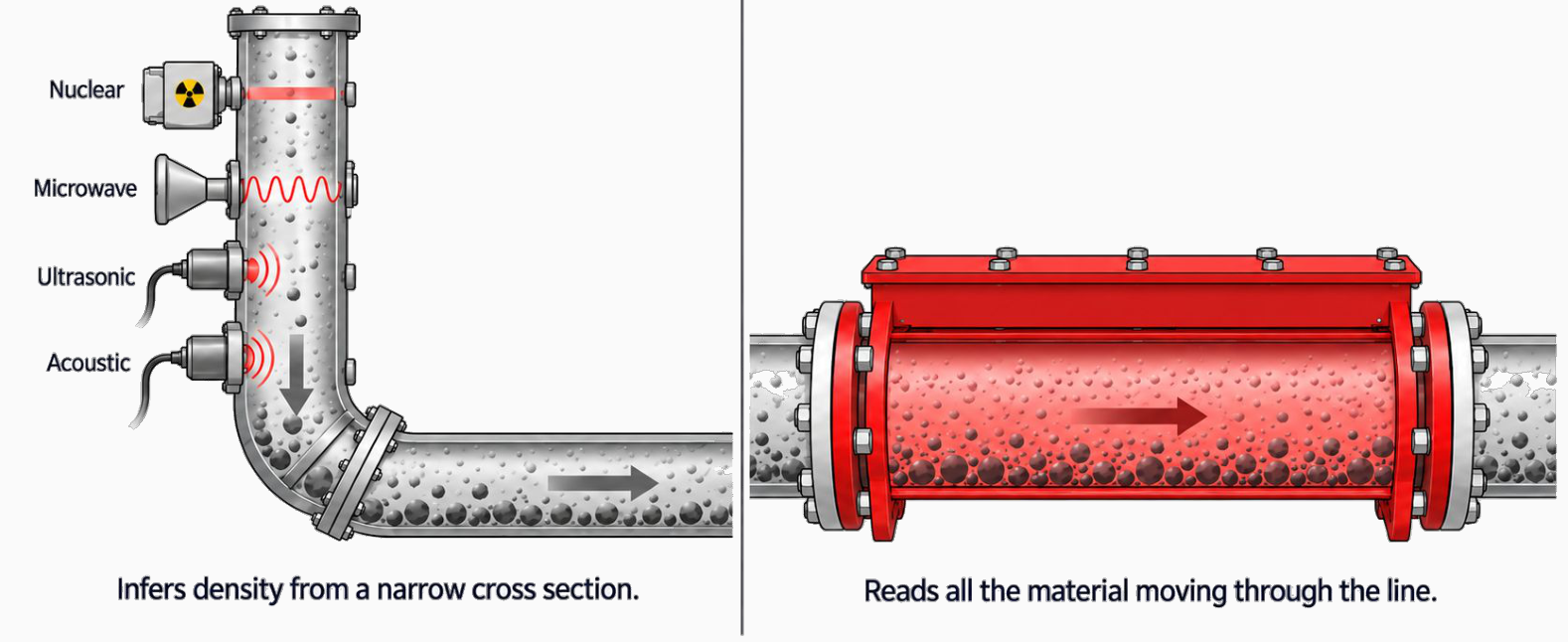
Comparison table
Section heading
Every principle against the full bore
| Technology | Principle | What is measured | Radiation source | Slurry limits | Typical applications |
|---|---|---|---|---|---|
| The Red Meter | A Class 1 laser reads deflection. Pressure and temperature corrections are applied. Density is reported in real time. | Full bore. Density, temperature, pressure and vibration at the same moment. | No radioactive source. Class 1 laser. | 2 in to 40 in pipe, rated for 0 psi and above. | Mining, dredging, oil and gas, and power. |
| Nuclear density gauges | Count rate of radiation through a layer of material. Denser material absorbs more gamma radiation. | A layer of material | Yes. Gamma radiation, constantly emitting. | Highest percent solids of the energy-based sensors. Vertical pipework. High pressure. | Mining and dredging. Also civil construction and petroleum. |
| Ultrasonic | Change in sound velocity and acoustic impedance. | The path the sound takes | No | Low percent solids. Low abrasion. Difficult on large diameters and fast slurries. | Where the meter may need to be moved. Some mining. Often in place of a nuclear gauge on low-density media. |
| Microwave | Microwave propagation speed, amplitude, time of flight, or phase shift. | A small cross-section at a time | No. Uses microwaves. | Loses accuracy as percent solids and pipe diameter increase. Best on stable percent solids. | Water and wastewater, pulp and paper, food and beverage, construction. |
| Conductivity | Change in density, in a similar way to a magnetic flow meter. | Density characteristics in the pipe | No | Needs stable flow velocity and conductive media. Low density and low solids only. | Dredging. High-abrasion duties where accuracy is low. |
| Coriolis | Force in a curved pipe from mass flow toward and away from a center of rotation. | Often a sample or slipstream, including on larger lines. Field average size 0.5 in. | No | Low tolerance for abrasive media. No tolerance for entrained gas. Impractical in large diameters. | Fluid-specific applications, including petroleum and natural gas. Also mining, food and beverage, chemical, and oil and gas. |
| Induced force | An actuator moves a rigid pipe section with a known force. Density comes from the acceleration. | The media in that pipe section | No | Lower accuracy on small density changes. Very large footprint. | Dredging, including heavy slurries where accuracy matters less. Some mining. |
| Percussion | Change in vibration from an impact on the outside of the pipe. | The vibration change at that impact | No | Low, stable densities on small pipes with low plant vibration. | Some water slurries. |
| Vibrational | Change in vibration. | Small diameters | No | Cannot handle suspended solids. Small diameters. | Pharmaceutical, water treatment, chemical. Used in liquids. |
Prose
Section heading
A sensor gives you a number. A control system runs your process.
A sensor measures one variable and shows it locally or sends it on. A control system takes inputs from several sensors and uses them to change the process. The Red Meter is a process control system.
The Red Meter takes continuous readings of density, temperature, pressure and vibration, and an integrated computer records them and calculates from them. You see the readings in Red Meter software and can send them to a third-party system. Remote access covers support, diagnostics, reporting and updates.
Link list
- Explore the TechnologyThe measurement, with the principle drawing.
- The Red MeterSpecifications and the install.
- Download specifications
- Estimate your savings
Call to action
Section heading
Bring the measurement you use now
Tell us the pipe size and the slurry. Then tell us what is on the line today, and we will tell you whether a Red Meter can sit inline with it.
Button, primary
Book a Demo